
What is ISO 41001?
ISO 41001:2018 is an internationally recognized standard for Facility Management (FM) Systems, developed and published by the International Organization for Standardization (ISO) in April 2018. It was developed by ISO/TC 267 — Facility Management, a dedicated technical committee that brings together global experts to define best practices in facility management.
The standard specifies the requirements for establishing, implementing, maintaining, and continually improving a Facility Management System (FMS) within an organization. It is designed to help organizations integrate people, place, process, and technology to ensure that facilities effectively support organizational objectives.
ISO 41001:2018 is applicable to all types of organizations — public or private, large or small — regardless of their sector or geographical location. In India, organizations across sectors such as IT parks, hospitals, manufacturing plants, commercial real estate, airports, and educational institutions are increasingly adopting this standard to modernize and professionalize their facility management operations.
Key Definitions
Facility Management (FM): An organizational function that integrates people, place, and process within the built environment, with the purpose of improving the quality of life of people and the productivity of the core business (ISO 41001:2018, Clause 3).
Demand Organization: The organization that sets the requirements and objectives for FM services.
Service Provider: The internal or external body that delivers FM services aligned with the demand organization’s requirements.
Scope and Applicability
ISO 41001:2018 is non-sector-specific, meaning it applies universally across industries. According to the standard’s abstract published on ISO.org, the requirements are applicable when an organization:
– Needs to demonstrate effective and efficient delivery of FM that supports the objectives of the demand organization.
– Aims to consistently meet the needs of interested parties and applicable requirements.
– Aims to be sustainable in a globally competitive environment.
In India, the rapid growth of smart cities, commercial infrastructure, and integrated townships has created a pressing need for structured facility management frameworks. ISO 41001 certification provides the ideal foundation for organizations operating in these dynamic environments to benchmark their FM operations against global standards.
Structure of ISO 41001:2018 (High-Level Clauses)
ISO 41001:2018 follows the Annex SL (High-Level Structure), which is the common framework shared with other ISO management system standards. The standard is organized into the following key clauses:
Clause 1 — Scope: Defines the boundaries and intent of the standard.
Clause 2 — Normative References: References ISO 41011:2017 (Facility management — Vocabulary) as the foundational vocabulary document.
Clause 3 — Terms and Definitions: Establishes terminology specific to facility management.
Clause 4 — Context of the Organization: Requires organizations to understand their internal and external context, identify interested parties, and define the scope of their FMS.
Clause 5 — Leadership: Addresses top management commitment, policy establishment, and roles and responsibilities within the FM function.
Clause 6 — planning: Covers risk and opportunity assessment, FM objectives, and planning to achieve them.
Clause 7 — Support: Encompasses resources, competence, awareness, communication, and documented information.
Clause 8 — Operation: Details operational planning and control, FM service agreements, the FM value chain, and service delivery processes.
Clause 9 — Performance Evaluation: Covers monitoring, measurement, analysis, evaluation, internal audit, and management review.
Clause 10 — Improvement: Addresses nonconformity, corrective action, and continual improvement of the FM system.
Annex A provides additional normative guidance on the use and interpretation of requirements within the standard.
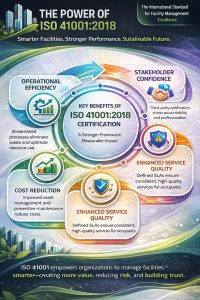
Who Should Get ISO 41001 Certified?
ISO 41001 is relevant for a broad range of organizations and industry verticals, including but not limited to:
- Corporate offices and IT/ITES parks
- Hospitals and healthcare facilities
- Hotels and hospitality establishments
- Manufacturing and industrial facilities
- Airports, ports, and transportation hubs
- Educational campuses and universities
- Government buildings and public institutions
- Real estate developers and property management companies
- Integrated facility management (IFM) service providers
In India, facility management has evolved from a support function to a strategic business enabler. Organizations seeking to compete at a national and global level are turning to ISO 41001 certification to formalize their FM governance and demonstrate service excellence.
ISO 41001 Certification Process
The journey to ISO 41001 certification typically involves the following stages:
Step 1 — Gap Analysis: A thorough assessment of the organization’s existing FM practices against the requirements of ISO 41001:2018 to identify areas of non-conformance and improvement.
Step 2 — planning and Documentation: Development of an FM system policy, objectives, risk register, service agreements, and documented procedures aligned with all clauses of the standard.
Step 3 — Implementation: Deployment of the FM system across relevant departments, facilities, and service delivery functions. Staff are trained on their roles and responsibilities within the FMS.
Step 4 — Internal Audit: An internal audit is conducted to assess the effectiveness of the implemented FM system and identify any non-conformities before the certification audit.
Step 5 — Management Review: Top management reviews the FM system’s performance, audit findings, and opportunities for improvement.
Step 6 — Stage 1 Audit (Documentation Review): The certification body reviews the organization’s documented FM system to ensure it meets the requirements of ISO 41001:2018.
Step 7 — Stage 2 Audit (Certification Audit): An on-site assessment is conducted by accredited auditors to verify that the FM system has been effectively implemented and is operational.
Step 8 — Certification Issuance: Upon successful completion of the Stage 2 audit, the ISO 41001:2018 certificate is issued. Certificates are typically valid for three years, subject to annual surveillance audits.
Step 9 — Surveillance Audits: Annual surveillance audits ensure ongoing conformance and continual improvement of the FM system.
Step 10 — Recertification: At the end of the three-year cycle, a recertification audit is conducted to renew the certificate.
ISO 41001 and Sustainable Development Goals (SDGs)
ISO 41001 contributes directly to several United Nations Sustainable Development Goals (SDGs). These include:
SDG 4 — Quality Education
SDG 9 — Industry, Innovation and Infrastructure
SDG 10 — Reduced Inequalities
SDG 11 — Sustainable Cities and Communities
SDG 12 — Responsible Consumption and Production
SDG 13 — Climate Action
For organizations in India committed to Environmental, Social, and Governance (ESG) frameworks and the national sustainability agenda, ISO 41001 certification supports alignment with these global development priorities through responsible and efficient facility management.
Why Choose EAS?
Empowering Assurance Systems (EAS) is a trusted and globally recognized certification body with extensive experience in auditing and certifying management systems across diverse industries. Here is why organizations — particularly those in India — choose EAS for their ISO 41001 certification journey:
Accredited Certification Body:
EAS operates under internationally recognized accreditation, ensuring that certificates issued carry credibility and global acceptance across markets, clients, and regulators.
Domain-Experienced Auditors:
EAS deploys auditors who possess real-world facility management expertise, enabling them to conduct meaningful, value-adding audits rather than checkbox-driven assessments.
Efficient Certification Process:
EAS offers a streamlined certification pathway with clearly defined timelines, minimizing disruption to your ongoing operations while ensuring thorough and compliant audit execution.
Tailored Support:
EAS provides guidance on documentation requirements, audit readiness, and gap analysis, helping Organizations Bridge the distance between their current FM practices and the requirements of ISO 41001:2018.
Post-Certification Value:
Beyond certification issuance, EAS maintains ongoing engagement through structured surveillance audits, helping organizations sustain, improve, and maximize the value of their ISO 41001-certified FM systems.
Global Recognition:
EAS certifications are recognized by international accreditation bodies, enabling certified organizations to demonstrate FM excellence to multinational clients, investors, and partners without barriers.
For personalized assistance, feel free to reach out to our customer care executives at +91 9962590571 or email us at enquiry@eascertification.com.
