
ISO 14001:2015 orgs must migrate before the IAF transition deadline.
Certification signals ESG commitment, compliance and stakeholder trust.
Early movers gain advantage in tenders, contracts and sustainability rankings.
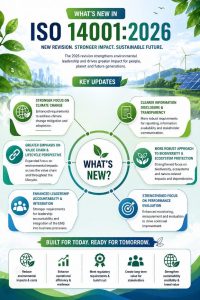
2026 covers climate risk, lifecycle thinking and ESG alignment — is your EMS ready?
Begin your journey — enquiry@eascertification.com
ISO 14001:2026 is now the global benchmark — get your organisation certified today.
ISO 14001:2015 orgs must migrate before the IAF transition deadline.
Certification signals ESG commitment, compliance and stakeholder trust.
Early movers gain advantage in tenders, contracts and sustainability rankings.
2026 covers climate risk, lifecycle thinking and ESG alignment — is your EMS ready?
Begin your journey — enquiry@eascertification.com
About ISO 14001 Certification in India
The ISO 14001 Environment Management System is a framework for establishing and maintaining an Environmental Management System to reduce the effects of your organization’s activities on the environment. It also covers international agreements, conventions, and treaties as well as legal obligations imposed by the government and local authorities. Any company, regardless of industry sector, size, or location can avail ISO 14001 certification.
Environmental Management System
ISO 14001 is a series of standards that specifies requirements for an Environmental Management System (EMS). ISO 14001 applies to all organizations regardless of their size or type or phase of operation and can be applied as risk-based EMS. 14001 Certification is one of the most widely sought after and globally recognized certifications for environmental management systems.
Why ISO 14001 Certification?
ISO 14001 Certification shows that your organization is following the ISO requirements for EMS as per ISO 14001 standard requirements. ISO 14001 Certification allows a company to demonstrate its commitment towards environmental safety and sustainability which helps in attracting customers from abroad. It also helps companies comply with local regulations to ensure the business does not incur hefty fines.
Why ISO 14001 Certification Matters for Your Business?
Environmental performance is now a real factor in winning work and keeping it. Buyers, regulators, and investors all look for proof that an organization manages its impact responsibly. ISO 14001 gives you that proof through an independently audited management system. Here is why the certification is worth pursuing:
- Credibility you can show. A certificate from an accredited body tells customers your environmental claims are backed by an external audit, not just internal opinion.
- Easier regulatory compliance. The standard pushes you to track legal obligations, which lowers the risk of fines and penalties.
- Lower operating waste. Mapping how energy, water, and materials flow through your processes often reveals savings that pay back the effort.
- Better access to tenders. Many large buyers and government contracts list ISO 14001 as a qualifying requirement.
- Stronger reputation. A recognized environmental commitment supports your brand with customers, communities, and staff.
- A culture of improvement. The system keeps environmental goals in front of your team rather than treating them as a one-off project.
ISO 14001 Certification in India
Being a common standard, ISO 14001 Certification in India is gaining ground with a high level of demand among large corporations. ISO 14001 Certification in India is generally claimed by companies that are involved in activities that may have a detrimental impact on the environment.
There are many advantages of ISO 14001 certification for companies looking forward to implementing its requirements with a focus on GHGs emission, energy conservation, and sustainable business development. With increasing greenhouse gases and immense pressure on organizations to reduce their carbon footprint, getting ISO 14001 Certification in India is a way to demonstrate commitment to a healthy environment.
Key Requirements of ISO 14001
ISO 14001:2015 follows the same high-level structure used across modern ISO management standards. To become certified, your organization needs a working EMS that meets the core clauses of the standard. The main building blocks are:
- Context and scope. Define what your EMS covers, including the activities, sites, and stakeholders that influence your environmental performance.
- Environmental policy. Set a clear policy, backed by leadership, that commits to compliance and continual improvement.
- Environmental aspects and impacts. Identify how your operations interact with the environment and decide which impacts are significant.
- Legal and other obligations. Keep an up-to-date record of the regulations and commitments that apply to you, and check that you meet them.
- Objectives and planning. Set measurable environmental objectives and plan the actions, resources, and timelines to reach them.
- Operational control and competence. Document key processes, train the people whose work affects the environment, and prepare for emergencies.
- Monitoring and internal audit. Measure performance, run internal audits, and review results so issues are found before the certification audit.
- Corrective action and review. Address non-conformities and hold management reviews that drive ongoing improvement.
Requirements to Achieve ISO 14001 Certification in India
- Establishing Environmental Policy and Objectives
- Environmental Aspect / Impact Assessment
- Create EMS documentation for all the processes for effective coordination of your team
- Define authority and responsibilities for the persons whose actions will have a negative impact on the environment
- Verify and ensure compliance with local legal requirements and interested party requirements
- Perform an internal audit of the EMS as per ISO 14001 requirements
- Carry out Corrective Actions on the NCs identified in the internal audit
Benefits of ISO 14001 Certification
- Comply with government regulations
- Enhanced credibility by becoming environmentally responsible
- Productivity increases due to better environmental performance
- Maintain good public image and relationship
- Employee health and safety are enhanced
- Opens up new trade avenues and new customers
Time Frame to Achieve ISO 14001 Certification
EAS can provide an immediate stage 1 audit if your application is successfully accepted. Stage 2 audits will also be commenced after the closure of non-conformities, if any, identified during the stage 1 audit. Upon successfully completing the stage 2 audit (please refer to the certification process), the certificate will be issued subsequently. For any small or medium size organization, the duration to achieve ISO 14001 certification is approximately 2-3 months.
Cost of Getting ISO 14001 Certification in India
The cost of ISO 14001 Certification in India varies based on the following factors. EAS is one of the most popular ISO 14001 certification bodies in India that has a transparent fee structure. We offer an approximate cost of ISO 14001 certification based on the following factors:
- Size of the organization
- Number of locations
- Risk Factors
- Number of employees
- Organization’s scope of activities
What Affects the Cost and Timeline of ISO 14001 Certification?
There is no single fixed price or fixed schedule for ISO 14001 certification, because every organization is different. Rather than quote a figure that may not fit your situation, it helps to understand the factors that move both cost and timeline up or down:
- Size and headcount. More employees and larger operations need more audit time, which affects the overall effort.
- Number of sites. Multiple or geographically spread locations may require additional audit days or sampling.
- Environmental risk and complexity. Operations with higher environmental impact usually call for deeper review than low-risk offices.
- Scope of activities. A broad scope covering many processes takes longer to audit than a narrow, focused one.
- Current readiness. Organizations with documented procedures and trained staff move faster than those starting from scratch.
- Internal preparation. Time spent on internal audits and closing gaps before Stage 1 shortens the path to a clean Stage 2.
- Certification cycle. Remember that certification runs on a three-year cycle with annual surveillance audits, so budgeting should look beyond the first year.
For a precise estimate that reflects your scope and locations, it is best to share your details with the EAS team so the proposal matches your actual needs.
How to Apply for ISO 14001 Certification?
EAS is one of the most experienced ISO 14001 certification bodies in India, accredited by JAS-ANZ to issue ISO certification. We have over 2 decades of experience in issuing ISO 14001 certification to organizations across the globe. Contact our experienced team of auditors to help you achieve ISO 14001 certification in a convenient and flexible manner. They will be able to provide advice and direction on choices that will help you achieve your objectives.
For Further Assistance – Contact US
To know more about the benefits of ISO 14001 Certification in India and ISO 14001 certification bodies in India, check the blog: ISO 14001 Standards and its Benefits
To stay updated on the latest changes to the standard, read our blog: ISO 14001 2026 Update – Changes & Benefits
Frequently Asked Questions about ISO 14001 Certification
Common questions about ISO 14001 certification, the audit process, and what it means for your organization.
What is ISO 14001 certification?
ISO 14001 is the international standard for an Environmental Management System (EMS). Certification means an accredited body has audited your organization and confirmed that your EMS meets the requirements of ISO 14001:2026. It is a recognized way to show that you manage your environmental impact in a structured, accountable manner.
Who needs ISO 14001 and is it mandatory?
ISO 14001 is voluntary. It applies to any organization, of any size or sector, that wants to manage and reduce its environmental impact. Many companies pursue it because customers, tenders, or parent organizations expect it, even though no law forces the certification itself.
How does the EAS certification audit work?
EAS uses a two-stage audit. The Stage 1 audit reviews your documentation and readiness. After any gaps are closed, the Stage 2 audit assesses how your EMS works in practice. Once the Stage 2 audit is successful, the certificate is issued.
How long is an ISO 14001 certificate valid?
The certificate runs on a three-year cycle. To keep it valid, your organization goes through annual surveillance audits during that period, followed by a recertification audit before the cycle ends.
Why choose an accredited certification body?
EAS is accredited by JAS-ANZ, which means our certification work is itself overseen against international rules. An accredited certificate carries far more weight with customers and regulators than an unaccredited one, because it reflects an independent, recognized process.
How can a certificate be verified?
Genuine certificates can be checked. EAS provides a certificate verification facility, and accredited certificates can be confirmed so that your clients and partners can trust that your ISO 14001 status is current and valid.
