

Environmental management is entering a new era. What once revolved around documentation, audits, and compliance checklists is now transforming into something far more dynamic, intelligent, and business-critical. ISO 14001:2026 is not just an update—it is a clear signal that traditional environmental management systems are no longer enough.
Organizations today operate in a world shaped by climate risks, stricter regulations, and increasing stakeholder expectations. Customers, investors, and governments are no longer satisfied with promises; they demand measurable, real-time environmental performance. This is exactly where ISO 14001:2026 steps in.
For organizations operating in India, where industrial growth and environmental responsibility must go hand in hand, this new version presents both a challenge and an opportunity. It pushes businesses to move beyond compliance and toward intelligent, AI-driven sustainability.
 What Are the Key Changes in ISO 14001:2026?
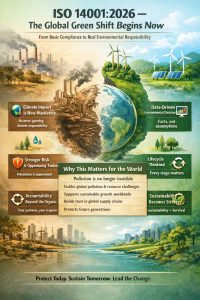 What Are the Key Changes in ISO 14001:2026?
- Real-time environmental monitoring replaces traditional audits
Organizations are expected to implement continuous tracking systems that monitor emissions, waste, and resource usage in real time. This shift ensures faster identification of issues and enables immediate corrective actions instead of delayed responses. - AI-driven risk identification becomes essential
Advanced analytics and AI tools help organizations predict environmental risks before they occur, reducing the likelihood of incidents. This proactive approach strengthens resilience and minimizes operational and regulatory disruptions. - Expanded lifecycle perspective across operations
Businesses must evaluate environmental impact across the entire lifecycle, from raw material sourcing to product disposal. This includes deeper scrutiny of suppliers, logistics, and end-of-life processes to ensure complete accountability. - Stronger alignment with business strategy and leadership goals
Environmental objectives are now expected to align directly with core business strategies, making sustainability a leadership priority. Top management becomes accountable for integrating environmental performance into decision-making processes. - Simplification through automation and smart systems
Automation reduces the burden of manual documentation, reporting, and compliance tracking. Intelligent systems improve efficiency, accuracy, and transparency, making environmental management easier to maintain and scale.
What Benefits Can Organizations Expect?
- Improved efficiency and resource optimization
Continuous monitoring helps organizations identify inefficiencies in energy, water, and material usage. This leads to optimized processes, reduced waste, and improved overall operational performance. - Significant cost savings over time
Predictive insights allow organizations to prevent environmental incidents and reduce penalties. Efficient resource management also lowers operational costs, delivering long-term financial benefits. - Better compliance with evolving regulations
Real-time data ensures organizations remain aligned with changing environmental laws and standards. This reduces the risk of non-compliance and helps avoid legal and financial consequences. - Enhanced brand image and stakeholder confidence
Transparent sustainability practices supported by data build trust with customers, investors, and regulators. This strengthens reputation and creates long-term business value. - Greater competitiveness in global markets
Organizations with advanced environmental systems meet international expectations more effectively. This improves their ability to secure global contracts and partnerships.
How AI is Transforming ISO 14001:2026 Implementation?
- Automated environmental data collection
AI-powered systems collect and process environmental data without manual intervention, reducing human error. This ensures accurate, consistent, and timely information for better decision-making. - Predictive performance analysis
Organizations can use AI to forecast trends in emissions, waste, and energy usage. These insights enable proactive planning and continuous improvement in environmental performance. - Smarter decision-making through insights
Real-time dashboards provide leadership with actionable insights, helping them make faster and more informed decisions. This improves responsiveness to environmental challenges. - Continuous improvement powered by machine learning
AI systems learn from historical data and identify patterns to optimize environmental strategies. This creates a cycle of ongoing improvement and innovation. - Integration across departments and supply chains
AI connects environmental management with operations, procurement, and compliance functions. This ensures a unified approach to sustainability across the entire organization.
Who Should Implement ISO 14001:2026 and Why?
- Manufacturing industries with high environmental impact
These organizations face strict environmental regulations and high resource consumption. Implementing ISO 14001:2026 helps them manage risks effectively and improve sustainability performance. - Export-oriented businesses targeting global markets
International clients increasingly demand strong environmental credentials. Adoption of this standard enhances credibility and supports access to global opportunities. - Construction and infrastructure companies
These sectors have significant environmental footprints and regulatory pressures. A structured environmental management system helps control impact and ensure compliance. - Small and medium enterprises aiming for growth
SMEs can use ISO 14001:2026 to build strong foundations for sustainable growth. Early adoption provides a competitive advantage and prepares them for future regulations. - Service-based organizations focusing on sustainability branding
Even with lower environmental impact, service companies can improve efficiency and reputation. Sustainability initiatives supported by ISO standards enhance brand value.
How to Prepare for ISO 14001:2026 Transition?
- Conduct a gap analysis of current environmental systems
Organizations should evaluate existing processes to identify gaps against new requirements. This helps prioritize improvements and plan a structured transition. - Invest in digital tools and AI-based platforms
Implementing smart technologies enables real-time monitoring and predictive analysis. These tools form the backbone of modern environmental management systems. - Train employees on modern environmental practices
Building awareness and skills ensures effective implementation of new systems. Employee engagement is critical for sustaining long-term improvements. - Strengthen supplier and lifecycle management processes
Organizations must ensure suppliers meet environmental standards and align with sustainability goals. This extends responsibility across the entire value chain. - Align environmental objectives with business strategy
Sustainability goals should be measurable and integrated into organizational planning. This ensures accountability and drives meaningful results.
Why ISO 14001:2026 Matters More Than Ever?
The environmental landscape is evolving rapidly. Climate change, resource scarcity, and stricter regulations are forcing organizations to rethink how they operate. ISO 14001:2026 reflects this reality by demanding systems that are not only compliant but also intelligent and adaptable.
In other regions of India, where industrial expansion is accelerating, the need for structured environmental management is even more critical. Organizations that delay adoption risk falling behind—not just in compliance, but in competitiveness and credibility.
This standard is not about doing more paperwork. It is about doing better business.
Final Insight
ISO 14001:2026 is not just another revision—it is a transformation. It challenges organizations to move beyond compliance and embrace intelligent environmental management.
Those who adapt early will not only meet regulatory expectations but will also unlock efficiency, innovation, and long-term sustainability. Those who delay may find themselves struggling to keep up in a world that is rapidly moving toward smarter, greener business practices.
The future of environmental management is already here—the only question is whether your organization is ready to lead or follow.
Frequently Asked Questions (FAQ)
Q: What is the main objective of ISO 14001:2026?
A: The main objective is to help organizations improve environmental performance through real-time monitoring, risk-based thinking, and integration with business strategy. It ensures that environmental management becomes a continuous, data-driven process rather than a periodic compliance activity.
Q: How is ISO 14001:2026 different from ISO 14001:2015?
A: It shifts focus from static documentation and periodic audits to dynamic, AI-driven systems that enable continuous monitoring and predictive decision-making. This allows organizations to act faster, reduce risks, and improve environmental outcomes with real-time insights.
Q: Is ISO 14001:2026 suitable for small businesses?
A: Yes, small businesses can adopt it gradually using scalable digital tools and focusing on their most critical environmental aspects. It offers flexibility, enabling SMEs to improve efficiency and sustainability without heavy upfront investment.
Q: What role does AI play in ISO 14001:2026?
A: AI enhances data collection, risk prediction, and performance analysis, making environmental management more proactive and efficient. It helps organizations identify trends, automate processes, and continuously improve their environmental strategies.
Q: Will certification become more difficult with ISO 14001:2026?
A: The expectations are higher, but automation and smart tools make implementation more structured and manageable. Organizations that embrace digital solutions early will find it easier to maintain compliance and performance consistency.
Q: How long does it take to transition to ISO 14001:2026?
A: The transition timeline depends on the maturity of existing systems and organizational readiness. Companies with established frameworks can upgrade faster, while others may need more time for system development and training.
Q: How does ISO 14001:2026 impact supply chains?
A: Organizations must assess and manage the environmental impact of suppliers, making sustainability a shared responsibility. This improves transparency, strengthens partnerships, and ensures consistent environmental standards across the value chain.
