

ISO 9001:2015 vs ISO 9001:2026: A Complete Clause-by-Clause Guide to What Has Changed
The sixth edition of the world’s most widely used management system standard was published on 16 September 2026. Here is exactly what moved, what stayed where it was, and what your quality management system actually has to do about it.
The One-Minute Version
- ISO 9001:2026 replaced ISO 9001:2015 on 16 September 2026. It is the sixth edition of the standard.
- It is a refinement, not a rewrite. The ten-clause Harmonized Structure, the process approach, PDCA and risk-based thinking all survive intact.
- Four changes carry real weight: quality culture and ethical behaviour become requirements under Clause 5; Clause 6.1 splits risk from opportunity; climate change is written permanently into Clauses 4.1 and 4.2; and a substantially expanded Annex A now explains Clauses 4 to 10.
- A three-year transition window is expected, with the exact deadline confirmed by the IAF communiqué. Organisations that leave it until 2029 will be competing for audit slots with everyone else.
Why Was ISO 9001 Revised?
Every ISO standard is reviewed on a cycle, and ISO 9001:2015 had reached the point where the world it described no longer matched the world its users worked in. Three pressures drove this revision.
The first was structural housekeeping. ISO’s Harmonized Structure — the common backbone shared by ISO 14001, ISO 45001, ISO 27001 and the rest — had been updated since 2015. Leaving ISO 9001 on the older text would have widened the gap for the very large number of organisations that run an integrated management system.
The second was the climate change amendment of 2024. That amendment was bolted on to more than thirty management system standards at once, as a short addition to the context clauses. A revision was the natural moment to absorb it into the running text rather than leave it as a patch.
The third, and the most interesting, was what auditors kept finding. Certification bodies worldwide reported the same pattern: systems that were procedurally immaculate and culturally hollow. Documented information in perfect order, and nobody on the floor able to say why any of it mattered. ISO/TC 176/SC 2 responded by making culture and ethical behaviour something the standard actually asks for, rather than something it hopes for.
The result, published as the sixth edition, is described by ISO as improving usability and keeping the standard relevant in a rapidly evolving digital landscape — with clearer language for organisations of every size, a stronger line on leadership and quality culture, and a cleaner distinction between risks and opportunities.
ISO 9001:2026: Evolution, Not Revolution
Almost every commentary on this revision has reached for the phrase “evolution, not revolution”, and it is accurate. Nothing in ISO 9001:2026 will force you to rebuild a functioning quality management system.
But that phrase is also where complacency starts. A small number of the new requirements are of a type that ISO 9001 has not previously asked for — behavioural and cultural rather than procedural — and they are the hardest kind to demonstrate at short notice. You cannot produce eighteen months of evidence that leadership promotes a quality culture in the fortnight before your transition audit. The changes are modest in volume and slow to evidence, which is a combination that rewards starting early.
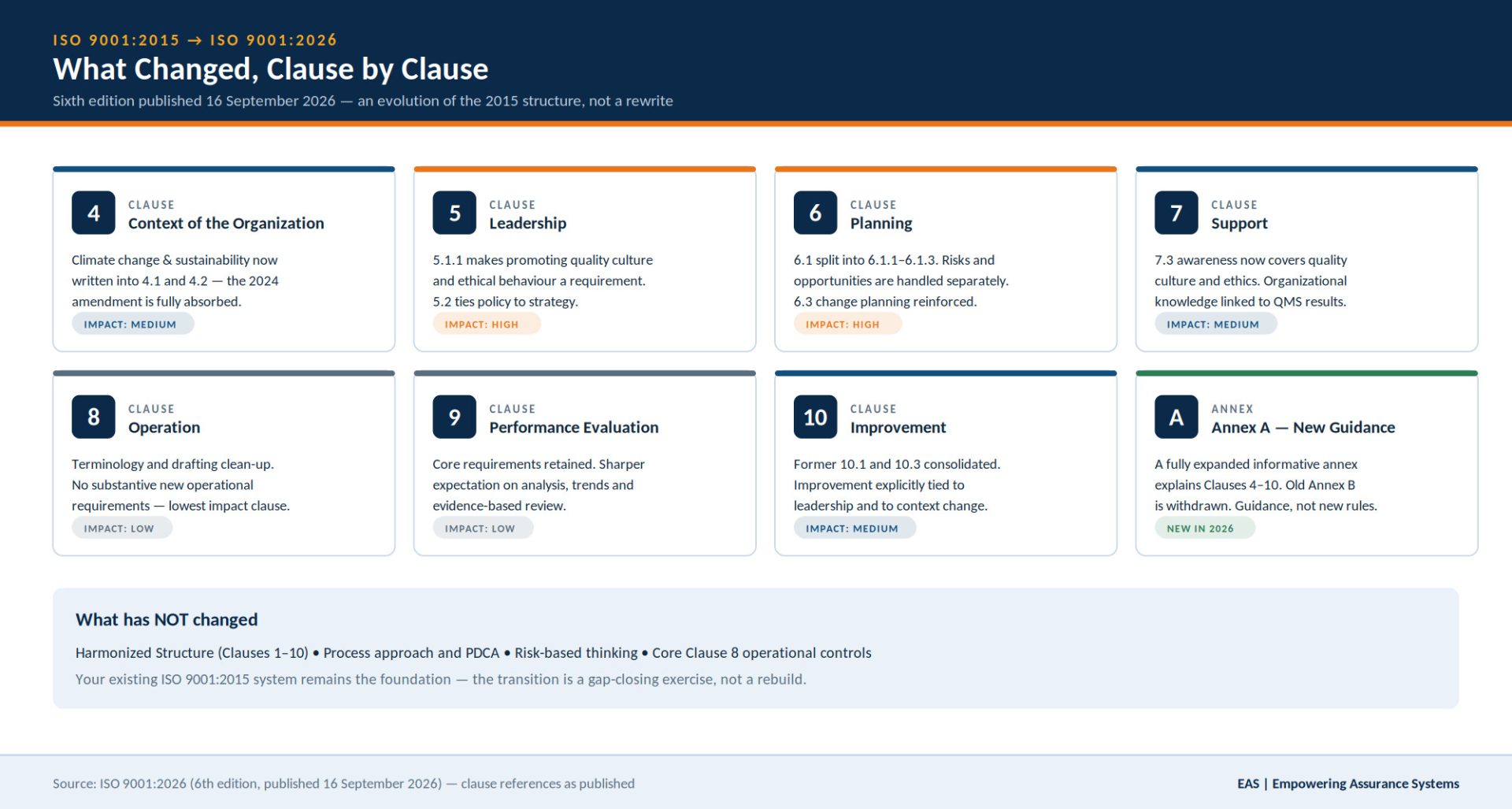
ISO 9001:2026 Changes, Clause by Clause
Clauses 1 to 3 — Scope, Normative References, Terms and Definitions
Clause 3 is where a quiet but practical change sits. ISO 9001:2026 now carries the relevant quality management terms within the standard itself, aligned to the Harmonized Structure and to ISO 9000:2026, which was published in May 2026. Previously you had to hold a second document to read the first one properly.
Two definitions matter more than the rest, because they are new anchors for requirements elsewhere: quality culture and ethical behaviour. Once a term is defined in Clause 3, it can be audited against in Clauses 5 and 7. That is precisely what has happened.
Clause 4 — Context of the Organization
4.1 Understanding the Organization and Its Context
The 2024 climate change amendment is now fully integrated. Your organisation must determine whether climate change is a relevant issue in its context. Note what the requirement does and does not say: it asks you to consider and conclude, not to build a carbon programme. An organisation that determines climate change is not a relevant issue for its quality outcomes, and can show how it reached that conclusion, is conforming.
In practice this is the difference between a one-line entry in your context analysis and a finding. Most organisations will find at least one honest link — supply chain disruption from extreme weather, regulatory change affecting product specifications, customer sustainability requirements flowing down as contractual conditions, or energy and material availability affecting process stability.
4.2 Understanding the Needs and Expectations of Interested Parties
The companion half of the climate amendment sits here: relevant interested parties can have requirements related to climate change. Beyond that, expectations around identifying interested parties and tracking what they actually require have been sharpened rather than expanded.
4.3 and 4.4 — Scope, and the QMS and Its Processes
Drafting improvements and clearer language. If your scope statement and process map were sound under the 2015 edition, they remain sound. Re-issue documents to reference the 2026 edition, and move on.
Clause 5 — Leadership
This is one of the two clauses that genuinely changes what an auditor will ask you for.
5.1.1 Leadership and Commitment — General
Top management must now demonstrate leadership and commitment by promoting a quality culture and ethical behaviour. In the 2015 edition, anything resembling this lived in guidance and in the quality management principles — useful, but not auditable. It is now part of the requirement set, sitting alongside the familiar obligations to take accountability for QMS effectiveness, ensure resources, and engage and support people.
The obvious question is what an auditor can reasonably ask to see. The answer is behavioural evidence, not a new procedure: leadership communications that name quality culture and mean something by it; a code of conduct or ethics policy that is connected to the QMS rather than filed separately by HR; how conflicts between quality and delivery pressure are actually resolved and recorded; management review minutes that discuss culture as a topic and not as a heading.
5.2 Quality Policy
The quality policy must now take account of the context of the organisation and support its strategic direction more explicitly than before. The framed statement in reception that could belong to any organisation in any industry is the thing this change is aimed at. If your policy would read identically at a competitor’s site, it does not reflect your context.
5.3 Organizational Roles, Responsibilities and Authorities
Substantially unchanged. Clarified language only.
Clause 6 — Planning
The second clause with real consequences, and the biggest structural change in the standard.
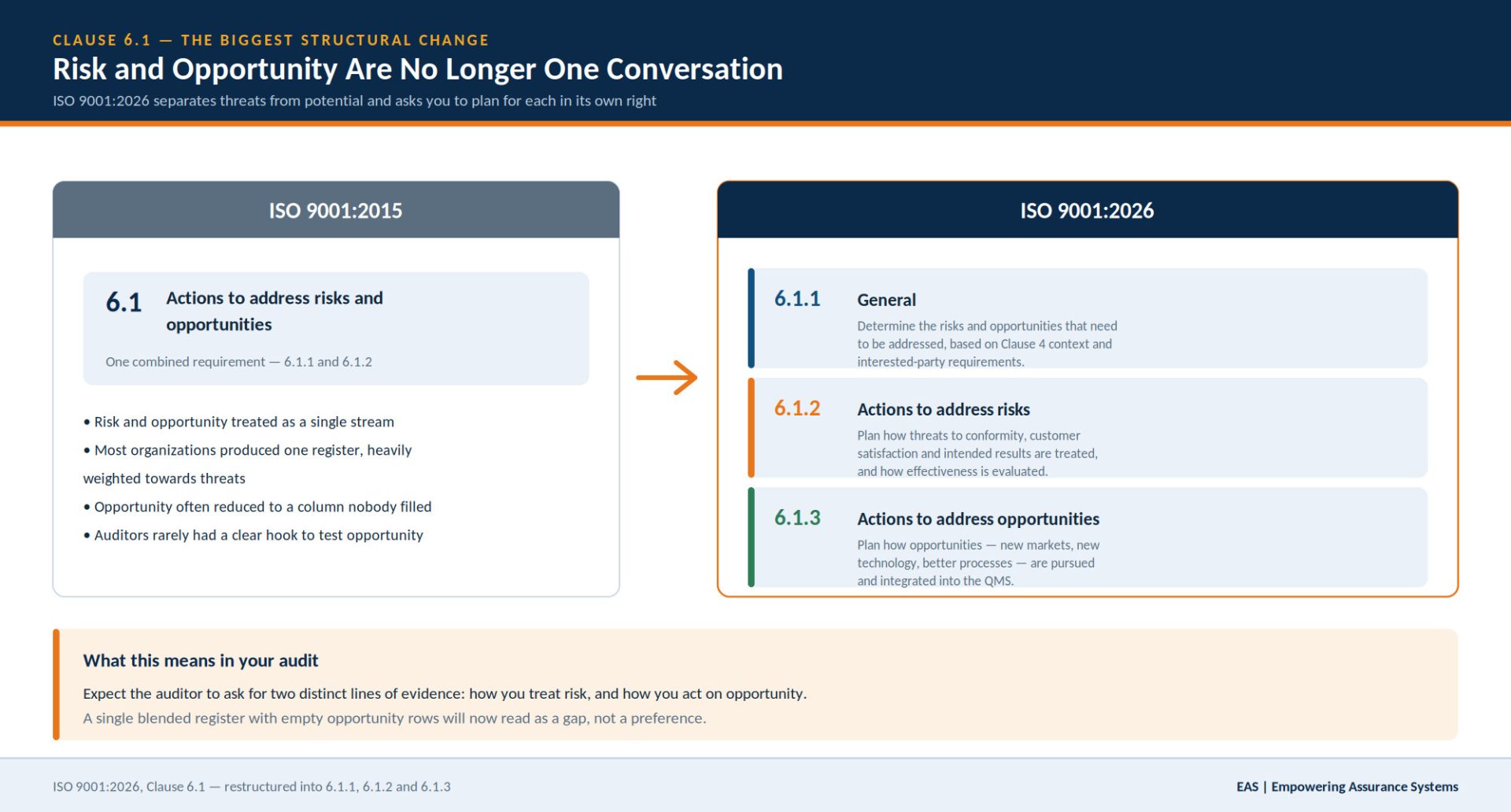
6.1 Actions to Address Risks and Opportunities
In ISO 9001:2015, risks and opportunities were addressed together in a single stream. The predictable result, across hundreds of thousands of certified organisations, was a risk register with a heavily populated threat column and an opportunity column that had been filled in once, during implementation, and never revisited.
ISO 9001:2026 separates them. Clause 6.1 is restructured into sub-clauses that distinguish the determination of risks and opportunities from the planning of actions for each — a general requirement, then actions to address risks, then actions to address opportunities. The guidance in Annex A on this clause is significantly expanded.
What this means practically: your organisation needs two visible lines of thinking. One asks what could stop you delivering conforming product and satisfied customers, and how you treat it. The other asks what could make you materially better — a new market, a process redesign, an automation opportunity, a capability you could build — and how you pursue it. Opportunity is no longer a column. It is a planning obligation with its own evaluation of effectiveness.
6.2 Quality Objectives and Planning to Achieve Them
Requirements are broadly retained, with a firmer expectation that objectives connect upward to strategic direction and downward to the processes that deliver them. Objectives that exist only in the quality manual, disconnected from how the business measures itself, sit awkwardly against the revised Clause 5.2.
6.3 Planning of Changes
Reinforced. Change management in the 2015 edition was three short bullet points that many organisations satisfied with a change log. The 2026 edition strengthens what is expected around planning changes to the QMS, including how changes are communicated, monitored, evaluated and reviewed — so that changes support the intended results rather than quietly undermining them.
If your organisation has been through an ERP implementation, a site relocation, a leadership restructure or an acquisition since your last audit, this is the clause that will be tested against those events.
Clause 7 — Support
Clause 7 has been restructured and tidied throughout, with one substantive addition and one useful extension.

7.1.6 Organizational Knowledge
Expanded, with knowledge explicitly linked to achieving the intended results of the QMS. This is a clause many organisations have treated lightly since 2015 — a note that experienced staff exist and that training records are kept. The revision pushes towards something more deliberate: what knowledge your processes actually depend on, where it currently sits, and what happens to your intended results when the person holding it leaves. For organisations facing generational turnover in skilled roles, this is worth real attention.
7.3 Awareness
Everyone doing work under your organisation’s control must now be aware of the quality culture and ethical behaviour of the organisation, in addition to the existing requirements around the quality policy, relevant objectives, their contribution to effectiveness, and the implications of not conforming.
This is the point at which culture stops being a boardroom topic. Induction content, toolbox talks and refresher training all need updating, and — more demandingly — the people receiving them need to be able to say something credible when an auditor asks. Awareness has always been tested by conversation on the shop floor rather than by signature sheets, and that will not change. It is also the practical reason to put your own people through ISO 9001 internal auditor training before the transition audit rather than after it.
7.2, 7.4 and 7.5 — Competence, Communication, Documented Information
Clarified wording. Documented information requirements are not materially expanded. Your existing document control arrangements carry over; update the references to the 2026 edition as you revise each document rather than in one large exercise.
Clause 8 — Operation
The clause that carries the most requirements is the clause that changed least. Clause 8 sees terminology alignment and drafting improvements, without substantive new operational requirements. Design and development, control of externally provided processes, production and service provision, release and nonconforming output all carry forward.
For most organisations this is the most reassuring paragraph in the standard: the part of your system that touches the product every day is the part you do not have to reopen.
Clause 9 — Performance Evaluation
Core requirements for monitoring, measurement, analysis and evaluation, internal audit and management review are retained. The revision sharpens the expectation that analysis produces something — trends, insight, decisions — rather than a monthly pack that is tabled and noted.
Two practical consequences. Your internal audit programme needs its criteria updated to the 2026 clause set, including the new culture and opportunity requirements. And your management review agenda needs inputs that cover quality culture and the effectiveness of actions taken on opportunities, not only on risks.
Clause 10 — Improvement
Clause 10 has been consolidated. What was previously split across 10.1 and 10.3 is brought together into a cleaner treatment of continual improvement, and the guidance explains that improvement can be prompted by changes in context, by risks and opportunities, and by the adoption of new technology. Leadership’s role in driving and supporting improvement is made more explicit, connecting Clause 10 back to Clause 5. Clause 10.2 on nonconformity and corrective action is unchanged in substance.
Annex A — The Genuinely New Content
The most substantial addition in the 2026 edition is not a requirement at all. Annex A has been significantly expanded into clause-by-clause guidance covering Clauses 4 to 10, and the former Annex B has been withdrawn with its content consolidated.
Annex A is informative. It adds no obligations. But it is now the first place to look when a requirement is ambiguous, and it will shape how auditors interpret the new culture and opportunity requirements. Anyone preparing for transition should read it before reading commentary about it.
What Has Not Changed in ISO 9001:2026?
It is worth stating plainly, because anxiety about a new edition tends to outrun the facts.
- The Harmonized Structure and the ten-clause numbering are unchanged, so integrated management systems stay aligned.
- The process approach and PDCA remain the organising logic of the standard.
- Risk-based thinking is retained — it has been clarified, not replaced.
- There is still no requirement for a quality manual, a management representative, or a prescribed documented procedure set.
- Clause 8 operational controls carry forward essentially as they were.
- Existing ISO 9001:2015 certificates remain valid through the transition window.
ISO 9001:2026 Transition Timeline
ISO 9000:2026 was published in May 2026, the FDIS of ISO 9001 circulated in July 2026, and ISO 9001:2026 was published on 16 September 2026. Publication is the date that matters, because the transition clock runs from it.
A three-year transition window is expected, consistent with the move from the 2008 to the 2015 edition, which ran from September 2015 to September 2018. The exact deadline is set by the International Accreditation Forum communiqué rather than by ISO, so confirm dates with your certification body before you build a plan around them. Certification bodies themselves also need their accreditation extended to the new edition before they can issue certificates against it.
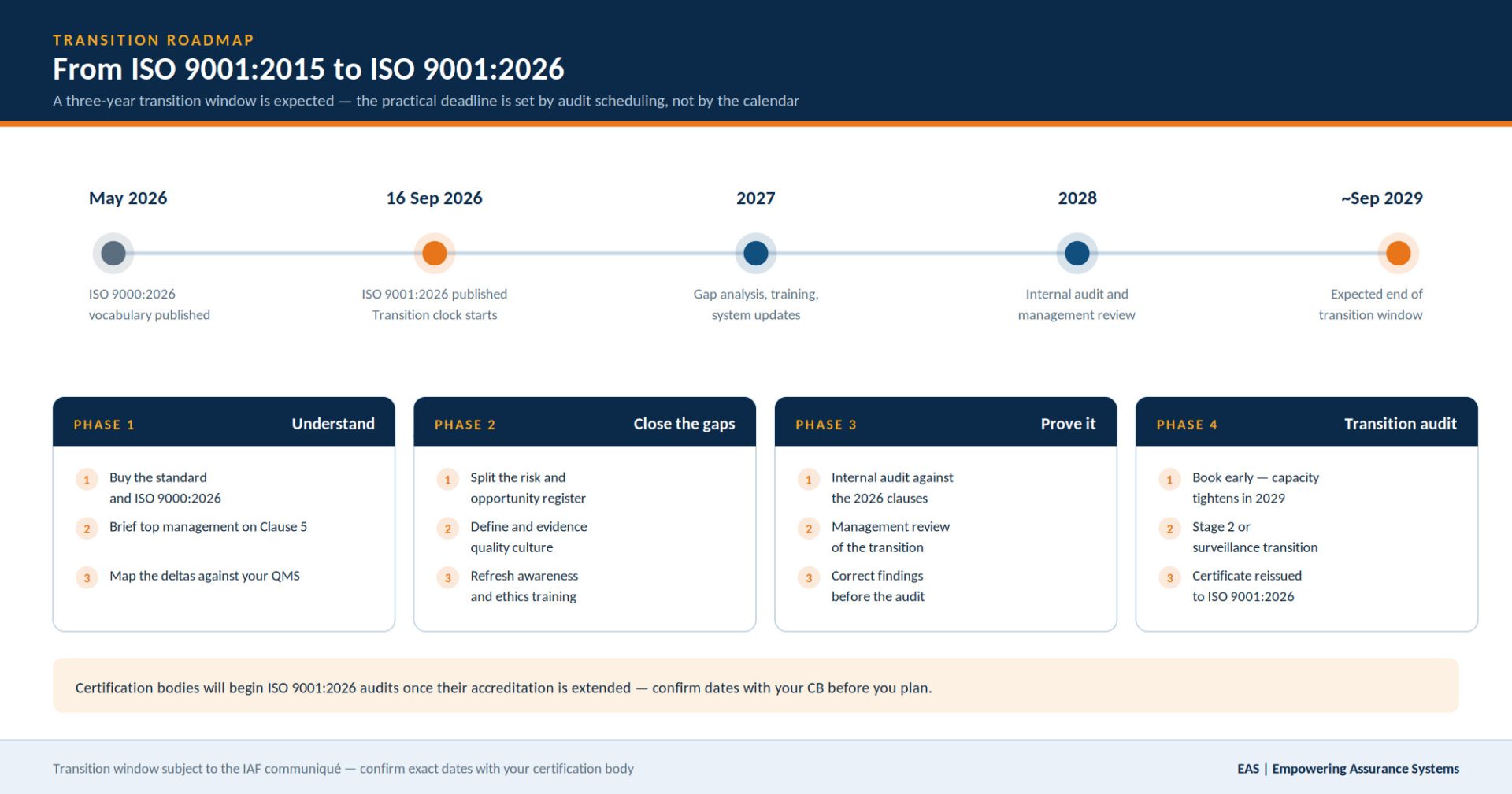
A Practical Transition Plan
Three years sounds generous. It is not, once you account for the fact that behavioural evidence needs an audit cycle to accumulate and that certification body capacity tightens sharply in the final year of any transition.
Months 1 to 3 — Understand
- Obtain ISO 9001:2026 and ISO 9000:2026. Work from the standard, not from summaries — including this one.
- Brief top management specifically on Clause 5. This is the change that requires their behaviour, not the quality team’s paperwork.
- Run a structured gap analysis, clause by clause, and rate each gap by the time it takes to close rather than by effort.
Months 4 to 12 — Close the Gaps
- Separate your risk and opportunity registers, and populate the opportunity side with things the business genuinely intends to pursue.
- Define what quality culture means in your organisation, in your own words, and decide how you will evidence it.
- Update the quality policy so that it reflects your context and strategy specifically.
- Revise induction and refresher training to cover culture and ethical behaviour, and run it.
- Strengthen change planning under 6.3 so that significant changes are communicated, monitored and reviewed.
- Revisit organizational knowledge under 7.1.6 against your critical processes.
Months 13 to 24 — Prove It
- Retrain internal auditors on the 2026 requirements, then audit the full system against the new clause set.
- Put quality culture and opportunity effectiveness on the management review agenda as standing items.
- Close findings and let the evidence build across at least one full cycle.
Months 25 Onwards — Transition Audit
- Book with your certification body early. Capacity in the final year of a transition is the single most common cause of missed deadlines.
- Transition is usually handled at a surveillance or recertification audit, with additional time allocated.
- Your certificate is reissued to ISO 9001:2026 once findings are closed.
If you are running the same exercise on other standards, the ISO 14001 migration lead auditor training and ISO 45001 migration lead auditor training courses follow the same shape, and the upcoming dates for all of them sit on the EAS training schedule.
Five Transition Mistakes to Avoid
- Treating culture as a document. Writing a quality culture policy and filing it satisfies nobody. The requirement is behavioural, and it is tested by asking people questions.
- Leaving the opportunity register empty. Under the 2015 edition a thin opportunity column was tolerated. Under 6.1.3 it reads as a gap.
- Waiting for your certification body to tell you. Certification bodies transition their own accreditation first. Your preparation should be under way before they call.
- Rewriting the whole system. This revision does not require it, and a wholesale rewrite introduces more nonconformity risk than it removes.
- Booking the transition audit late. The last six months of any transition window are the worst time to need an auditor.
Preparing Your Team for ISO 9001:2026
The 2026 revision is modest in volume and demanding in the kind of evidence it asks for. The organisations that transition smoothly will be the ones whose people understand why the requirements changed — not just which clause numbers moved.
EAS (Empowering Assurance Systems) supports organisations across India, the UAE, Malaysia, Singapore, Indonesia, Australia and the USA with:
- ISO 9001 Lead Auditor training — the IRCA-accredited course, being updated for the sixth edition, for auditors who need to audit against the new clause set.
- ISO 9001:2026 transition and awareness sessions — short-format briefings for management teams, internal auditors and process owners.
- Internal auditor training for organisations rebuilding their internal audit programme around the 2026 requirements, alongside the wider ISO training course range.
- Gap analysis and implementation support — a structured clause-by-clause review of your existing QMS against ISO 9001:2026, with a prioritised closure plan.
- ISO 9001 certification itself, and ISO 14001 and ISO 45001 certification where the transition is part of an integrated programme.
Start your transition now.
Talk to the EAS team about a clause-by-clause gap analysis of your quality management system, or book your people onto an ISO 9001 Lead Auditor or transition course. Contact us to discuss your transition plan.
This article summarises the changes introduced by ISO 9001:2026 for general guidance. Clause references reflect the standard as published. Organisations should work from their own licensed copy of ISO 9001:2026 and confirm transition dates with their certification body.
Frequently Asked Questions
What happens if we miss the transition deadline?
Certificates issued against a withdrawn edition cease to be valid once the transition deadline passes. Recovering from that position usually means a fresh certification cycle rather than a transition audit, which takes longer and costs more than transitioning on time.
When can certification bodies actually start issuing ISO 9001:2026 certificates?
Not immediately. A certification body has to have its own accreditation extended to the 2026 edition before it can issue certificates against it, and accreditation bodies work through that queue after publication. Ask your certification body directly when its accreditation is expected to cover the new edition, because it sets the earliest date your transition audit can happen.
We are not certified yet. Should we certify to ISO 9001:2015 now, or wait for 2026?
It depends on how soon you need the certificate. Certifying to the 2015 edition now gives you a valid certificate immediately, but you will transition later within the same window. Waiting means building the system against the current edition from the start and avoiding the second exercise — at the cost of not holding a certificate in the meantime. If a customer or tender needs the certificate this year, certify now.
Will transitioning cost extra?
Transition is normally handled at a scheduled surveillance or recertification audit with additional audit time allocated, rather than as a separate visit, so the incremental audit cost is usually modest. The larger cost is internal — training, gap closure and the internal audit cycle that produces the evidence. Your certification body will quote the audit element; ask early, because that quotation also secures a slot.
Do we need ISO 9000:2026 as well as ISO 9001:2026?
ISO 9001:2026 now carries the quality management terms it uses within the standard itself, so you can read it without a second document. ISO 9000:2026 is still worth having where your team debates the meaning of terms, or where you write procedures that quote definitions, but it is no longer a practical necessity for reading the requirements.
We are certified to ISO 14001 and ISO 45001 as well. Does this break our integrated system?
No. The Harmonized Structure is retained and the alignment between standards is improved rather than reduced. Plan the ISO 9001 transition as part of your integrated audit programme rather than as a separate project.


ISO 14001 Standards and Its Benefits

ISO 14001 is the international standard for environmental management systems (EMS), setting out what an organization must do to identify, control, and continually improve its environmental impact. The standard was revised in 2026 — ISO 14001:2026 is now the current edition, replacing ISO 14001:2015, which remains valid for existing certificate holders only through 14 April 2029.
This guide covers what the standard actually requires, what changed between the 2015 and 2026 editions, and the concrete business benefits certification delivers — not just the compliance case, but the operational and commercial reasons organizations pursue it.
What Does ISO 14001 Require?
ISO 14001 is built around the Plan-Do-Check-Act management cycle applied to environmental performance. In practice, that breaks down into a handful of core requirements an auditor checks: a documented environmental policy signed by top management; identification of environmental aspects (the parts of your activities that interact with the environment — emissions, waste, water and energy use) and their impacts; a legal and regulatory compliance register covering every environmental obligation that applies to your operations; documented objectives and targets tied to your most significant aspects; operational controls that actually manage those aspects day to day; emergency preparedness and response procedures; and a cycle of internal audit and management review that keeps the whole system honest and current rather than static.
Since the 2026 revision, two additional expectations sit inside that same structure: organizations must explicitly consider climate-related risks and opportunities as part of their environmental context, and life-cycle thinking must extend visibly across design, procurement, logistics, product use, and end-of-life disposal — not stop at the factory gate.
What Changed in ISO 14001:2026 Compared With the 2015 Edition?
ISO 14001 was published in its current 2026 form on 15 April 2026. The revision does not tear up the 2015 structure — the same core clauses and PDCA cycle remain — but it sharpens what sits inside several of them. Climate-related risks and opportunities now have to be explicitly considered as part of organizational context, reflecting over a decade of accumulated pressure on environmental standards to address climate directly rather than leave it as an implicit, optional consideration. Life-cycle thinking becomes more concrete and auditable: design, procurement, logistics, product use, and disposal all need visible environmental-impact consideration, not just operational controls at the point of manufacture. Resource use — energy, water, materials — and circular-economy principles get sharper emphasis, matching how much more central these concepts have become to environmental management generally since 2015. Leadership accountability is reinforced, with clearer expectations for how environmental performance flows to top management and out through supplier and value-chain scrutiny. And external communication and reporting expectations are elevated, reflecting how much environmental data now flows into customer questionnaires, tenders, and investor ESG reporting compared to a decade ago.
For organizations already certified under ISO 14001:2015, none of this creates an immediate compliance gap. Existing certificates remain valid through 14 April 2029, a 36-month transition window set by the IAF. What it does create is a planning task: a gap analysis against the 2026 clauses, updates to environmental documentation, and internal audit team training, ideally folded into your next scheduled surveillance or recertification audit rather than requiring a separate assessment.
The Business Benefits of ISO 14001 Certification
- Lower regulatory risk: systematic identification and control of environmental aspects reduces the chance of a compliance breach becoming an enforcement action rather than a managed process — directly relevant under India’s Environment (Protection) Act, 1986 and the various state Pollution Control Board consent regimes it operates through.
- Real operating-cost savings: structured energy, water, and materials monitoring — sharpened further under the 2026 revision’s resource-use emphasis — regularly surfaces real, measurable savings once an organization actually looks at its own consumption data systematically.
- Access to supply chains and tenders: certification is increasingly a supplier-qualification requirement across manufacturing, export, and public-sector tender processes, and organizations without it are simply excluded from bidding regardless of their actual environmental performance.
- Stronger customer and investor confidence: a certified EMS gives concrete, auditable evidence for customer environmental questionnaires and investor ESG disclosures, replacing ad hoc compiled answers with a standing, structured system.
- Fewer disruptive incidents: fewer environmental incidents — spills, non-compliant waste disposal, unpermitted emissions — mean less operational disruption, lower insurance and remediation cost, and less reputational exposure.
- Better operational discipline generally: a documented, continually improving EMS tends to surface efficiency opportunities beyond pure environmental performance, since resource waste and process inefficiency are frequently the same underlying problem.
How Does ISO 14001 Relate to Other Environmental Frameworks?
Organizations sometimes confuse ISO 14001 with sector-specific or regional environmental schemes it doesn’t overlap with directly. It is not the same as an Environmental Impact Assessment (EIA) clearance, which is a project-specific regulatory approval process under India’s EIA Notification, 2006 — a certified EMS supports ongoing environmental management after a project is operational, not the pre-construction clearance itself. It is also not a carbon-neutrality or net-zero certification; ISO 14001 requires environmental aspects including, since 2026, climate-related risk to be managed, but achieving certification does not itself constitute a carbon-neutrality claim. Understanding this distinction matters when communicating certification externally — overstating what ISO 14001 covers in marketing material is a common and avoidable EEAT and credibility risk.
Is ISO 14001 Certification Mandatory in India?
No Indian law names ISO 14001 certification by name as mandatory. What is mandatory, depending on your operations, is the underlying environmental compliance — state Pollution Control Board consents, hazardous-waste and effluent-discharge rules, and obligations under the Environment (Protection) Act, 1986. ISO 14001 certification is the most direct, third-party-verified way to demonstrate that this compliance is systematic rather than incidental, which is why it functions as a de facto requirement in many supply chains and tenders even without a legal mandate naming it directly.
Who Needs ISO 14001 Certification?
- Manufacturers facing customer or OEM supplier-qualification requirements that increasingly name ISO 14001 explicitly.
- Organizations under close Pollution Control Board oversight needing structured environmental compliance evidence for consent-to-operate renewals and inspections.
- Export-oriented businesses answering overseas buyer environmental due-diligence questionnaires as part of export qualification.
- Listed companies and their subsidiaries needing structured, auditable environmental data for sustainability disclosures and investor ESG reporting.
- Any organization wanting a documented environmental commitment to support brand positioning and competitive bidding.
The Certification Process, Start to Finish
- Application and quotation – EAS reviews your industry, site count, and environmental risk profile and issues a tailored quotation; there is no fixed price, since these factors vary certificate to certificate.
- Gap analysis (optional) – an optional pre-audit review against ISO 14001:2026 that surfaces gaps while there is time to fix them before the formal audit.
- Stage 1 audit — documentation review – the auditor reviews your EMS documentation for completeness against the standard before scheduling a site visit.
- Stage 2 audit — implementation review – an on-site audit confirming the system operates as documented: aspect controls in practice, monitoring records, emergency-preparedness evidence.
- Corrective actions (if raised) – nonconformities above minor must be corrected and evidenced before certification; minor findings are closed with a corrective action plan verified at the next visit.
- Certificate issued – valid for three years with annual surveillance audits. Existing 2015 holders can align their 2026 transition assessment with their next scheduled surveillance or recertification audit.
For the full mechanics of scheduling and what each stage involves, see our ISO certification process guide.
Documentation You’ll Need to Get Started
- Environmental policy: signed by top management.
- Aspects and impacts register: your organization’s environmental aspects and impacts, ranked by significance.
- Legal and regulatory register: permits, consents, and authorizations covering every relevant obligation.
- Objectives and targets: with targets and timelines tied to your significant aspects.
- Emergency preparedness procedures: covering site-specific scenarios.
- 2026 gap-analysis findings (if migrating): for organizations already certified to ISO 14001:2015, a documented comparison against the 2026 clauses.
Common Misconceptions About ISO 14001
A few misunderstandings come up often enough to be worth addressing directly. First: ISO 14001 does not certify that an organization has zero environmental impact — no operation does. It certifies that environmental impact is identified, controlled, and continually improved through a functioning management system. An organization with genuinely significant environmental aspects can be validly certified if it manages them well; the standard is about management rigor, not the absence of impact.
Second: certification is not a one-time achievement. The three-year certificate requires annual surveillance audits to remain valid, and a system that was compliant at initial certification but allowed to lapse into a paperwork exercise will be caught at the next surveillance visit — auditors specifically look for evidence the system has kept operating, not just that it existed once. Third, and increasingly relevant given the 2026 revision: ISO 14001 is not a climate or carbon-accounting standard in itself. It requires climate-related risk to be considered as part of environmental context, but it does not produce a greenhouse-gas inventory or carbon footprint calculation — organizations needing formal GHG accounting alongside ISO 14001 should treat the two as complementary tools, not substitutes for each other.
Accreditation: Why It Matters
A certification body’s own accreditation is what makes a certificate meaningful to a third party. EAS holds accreditation from JAS-ANZ (Joint Accreditation System of Australia and New Zealand), an IAF member accreditation body, and is a CQI-IRCA Approved Training Partner. This means an independent authority has audited EAS’s own competence to certify management systems — a certificate issued without that backing is a private claim, not an internationally recognized credential.
Why Certify with EAS?
EAS (Empowering Assurance Systems) is a JAS-ANZ accredited certification body serving organizations across India. Our auditors assess environmental management systems against the same clauses your operations live by, so audits focus on whether environmental controls actually function day to day, not whether a policy binder exists.
See our main ISO 14001 Certification page for full certification details, or our ISO 14001 Lead Auditor and ISO 14001 Internal Auditor training pages if you’re building in-house audit competence alongside or instead of certification.
Get Started
Contact EAS for a tailored ISO 14001:2026 certification quotation, or to discuss migrating an existing ISO 14001:2015 certificate ahead of the 14 April 2029 deadline.
Office: 1495/1, Manasarovar, 16th Main Road, Anna Nagar West, Chennai – 600040
Get your ISO 14001:2026 certification quotation
Tell us about your organization and we will come back with a tailored quotation — or talk through migrating an existing ISO 14001:2015 certificate before the 14 April 2029 deadline.
| Call | +91 99625 90571 / +91 82206 66148 |
| enquiry@eascertification.com |
Frequently Asked Questions about ISO 14001 Standards and Certification
Common questions about the ISO 14001:2026 revision and the transition deadline.
Is ISO 14001:2015 certification still valid?
Yes, through 14 April 2029, the end of the IAF’s transition window. There is no immediate compliance gap for existing certificate holders.
Should a company certifying for the first time go straight to ISO 14001:2026?
Yes. First-time certification should target the current 2026 edition rather than certifying against a standard already mid-transition.
What’s the difference between ISO 14001 and ISO 45001?
ISO 14001 covers environmental management — emissions, waste, resource use. ISO 45001 covers occupational health and safety. Many organizations hold both, often audited together as an Integrated Management System.
How long does ISO 14001 certification take?
Typically eight to twelve weeks for organizations with reasonably organized EMS documentation; three to six months for organizations building an EMS from scratch.
Does ISO 14001 certification expire?
Certificates are valid for three years, with annual surveillance audits required to maintain validity, followed by a recertification audit at the three-year mark.
Can ISO 14001 be combined with other management-system certifications?
Yes. ISO 9001 (quality) and ISO 45001 (occupational health and safety) are commonly audited together with ISO 14001 as a single Integrated Management System, reducing total audit days and cost.
Does a small organization need the same EMS as a large manufacturer?
The clause structure is identical, but the scale is proportionate — a small organization’s aspects register, documentation, and internal audit program should reflect its actual size and risk profile, not mirror a large manufacturer’s system unnecessarily. EAS scopes the audit accordingly.
What happens if an organization fails to close a nonconformity in time?
Certification is withheld (for initial audits) or suspended/withdrawn (for existing certificates) until the nonconformity is closed and verified. This is one reason a pre-audit gap analysis is worth the modest additional cost — closing gaps before Stage 2 avoids this delay entirely.
Is ISO 14001 relevant to service businesses, or only manufacturing?
It’s relevant to any organization with environmental aspects worth managing, which includes most service businesses through energy use, waste, travel, and facilities management — the significance and depth of the EMS scales to match, but the standard applies regardless of sector.

The ISO 14001 Update in 2026 Is Bigger Than You Think – Are You Ready?
Environmental management is entering a new era. What once revolved around documentation, audits, and compliance checklists is now transforming into something far more dynamic, intelligent, and business-critical. ISO 14001:2026 is not just an update—it is a clear signal that traditional environmental management systems are no longer enough.
Organizations today operate in a world shaped by climate risks, stricter regulations, and increasing stakeholder expectations. Customers, investors, and governments are no longer satisfied with promises; they demand measurable, real-time environmental performance. This is exactly where ISO 14001:2026 steps in.
For organizations operating in India, where industrial growth and environmental responsibility must go hand in hand, this new version presents both a challenge and an opportunity. It pushes businesses to move beyond compliance and toward intelligent, AI-driven sustainability.
 What Are the Key Changes in ISO 14001:2026?
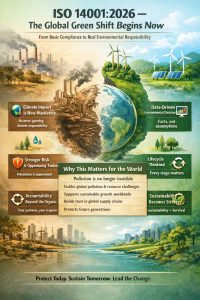 What Are the Key Changes in ISO 14001:2026?
- Real-time environmental monitoring replaces traditional audits
Organizations are expected to implement continuous tracking systems that monitor emissions, waste, and resource usage in real time. This shift ensures faster identification of issues and enables immediate corrective actions instead of delayed responses. - AI-driven risk identification becomes essential
Advanced analytics and AI tools help organizations predict environmental risks before they occur, reducing the likelihood of incidents. This proactive approach strengthens resilience and minimizes operational and regulatory disruptions. - Expanded lifecycle perspective across operations
Businesses must evaluate environmental impact across the entire lifecycle, from raw material sourcing to product disposal. This includes deeper scrutiny of suppliers, logistics, and end-of-life processes to ensure complete accountability. - Stronger alignment with business strategy and leadership goals
Environmental objectives are now expected to align directly with core business strategies, making sustainability a leadership priority. Top management becomes accountable for integrating environmental performance into decision-making processes. - Simplification through automation and smart systems
Automation reduces the burden of manual documentation, reporting, and compliance tracking. Intelligent systems improve efficiency, accuracy, and transparency, making environmental management easier to maintain and scale.
What Benefits Can Organizations Expect?
- Improved efficiency and resource optimization
Continuous monitoring helps organizations identify inefficiencies in energy, water, and material usage. This leads to optimized processes, reduced waste, and improved overall operational performance. - Significant cost savings over time
Predictive insights allow organizations to prevent environmental incidents and reduce penalties. Efficient resource management also lowers operational costs, delivering long-term financial benefits. - Better compliance with evolving regulations
Real-time data ensures organizations remain aligned with changing environmental laws and standards. This reduces the risk of non-compliance and helps avoid legal and financial consequences. - Enhanced brand image and stakeholder confidence
Transparent sustainability practices supported by data build trust with customers, investors, and regulators. This strengthens reputation and creates long-term business value. - Greater competitiveness in global markets
Organizations with advanced environmental systems meet international expectations more effectively. This improves their ability to secure global contracts and partnerships.
How AI is Transforming ISO 14001:2026 Implementation?
- Automated environmental data collection
AI-powered systems collect and process environmental data without manual intervention, reducing human error. This ensures accurate, consistent, and timely information for better decision-making. - Predictive performance analysis
Organizations can use AI to forecast trends in emissions, waste, and energy usage. These insights enable proactive planning and continuous improvement in environmental performance. - Smarter decision-making through insights
Real-time dashboards provide leadership with actionable insights, helping them make faster and more informed decisions. This improves responsiveness to environmental challenges. - Continuous improvement powered by machine learning
AI systems learn from historical data and identify patterns to optimize environmental strategies. This creates a cycle of ongoing improvement and innovation. - Integration across departments and supply chains
AI connects environmental management with operations, procurement, and compliance functions. This ensures a unified approach to sustainability across the entire organization.
Who Should Implement ISO 14001:2026 and Why?
- Manufacturing industries with high environmental impact
These organizations face strict environmental regulations and high resource consumption. Implementing ISO 14001:2026 helps them manage risks effectively and improve sustainability performance. - Export-oriented businesses targeting global markets
International clients increasingly demand strong environmental credentials. Adoption of this standard enhances credibility and supports access to global opportunities. - Construction and infrastructure companies
These sectors have significant environmental footprints and regulatory pressures. A structured environmental management system helps control impact and ensure compliance. - Small and medium enterprises aiming for growth
SMEs can use ISO 14001:2026 to build strong foundations for sustainable growth. Early adoption provides a competitive advantage and prepares them for future regulations. - Service-based organizations focusing on sustainability branding
Even with lower environmental impact, service companies can improve efficiency and reputation. Sustainability initiatives supported by ISO standards enhance brand value.
How to Prepare for ISO 14001:2026 Transition?
- Conduct a gap analysis of current environmental systems
Organizations should evaluate existing processes to identify gaps against new requirements. This helps prioritize improvements and plan a structured transition. - Invest in digital tools and AI-based platforms
Implementing smart technologies enables real-time monitoring and predictive analysis. These tools form the backbone of modern environmental management systems. - Train employees on modern environmental practices
Building awareness and skills ensures effective implementation of new systems. Employee engagement is critical for sustaining long-term improvements. - Strengthen supplier and lifecycle management processes
Organizations must ensure suppliers meet environmental standards and align with sustainability goals. This extends responsibility across the entire value chain. - Align environmental objectives with business strategy
Sustainability goals should be measurable and integrated into organizational planning. This ensures accountability and drives meaningful results.
Why ISO 14001:2026 Matters More Than Ever?
The environmental landscape is evolving rapidly. Climate change, resource scarcity, and stricter regulations are forcing organizations to rethink how they operate. ISO 14001:2026 reflects this reality by demanding systems that are not only compliant but also intelligent and adaptable.
In other regions of India, where industrial expansion is accelerating, the need for structured environmental management is even more critical. Organizations that delay adoption risk falling behind—not just in compliance, but in competitiveness and credibility.
This standard is not about doing more paperwork. It is about doing better business.
Final Insight
ISO 14001:2026 is not just another revision—it is a transformation. It challenges organizations to move beyond compliance and embrace intelligent environmental management.
Those who adapt early will not only meet regulatory expectations but will also unlock efficiency, innovation, and long-term sustainability. Those who delay may find themselves struggling to keep up in a world that is rapidly moving toward smarter, greener business practices.
The future of environmental management is already here—the only question is whether your organization is ready to lead or follow.
Frequently Asked Questions (FAQ)
Q: What is the main objective of ISO 14001:2026?
A: The main objective is to help organizations improve environmental performance through real-time monitoring, risk-based thinking, and integration with business strategy. It ensures that environmental management becomes a continuous, data-driven process rather than a periodic compliance activity.
Q: How is ISO 14001:2026 different from ISO 14001:2015?
A: It shifts focus from static documentation and periodic audits to dynamic, AI-driven systems that enable continuous monitoring and predictive decision-making. This allows organizations to act faster, reduce risks, and improve environmental outcomes with real-time insights.
Q: Is ISO 14001:2026 suitable for small businesses?
A: Yes, small businesses can adopt it gradually using scalable digital tools and focusing on their most critical environmental aspects. It offers flexibility, enabling SMEs to improve efficiency and sustainability without heavy upfront investment.
Q: What role does AI play in ISO 14001:2026?
A: AI enhances data collection, risk prediction, and performance analysis, making environmental management more proactive and efficient. It helps organizations identify trends, automate processes, and continuously improve their environmental strategies.
Q: Will certification become more difficult with ISO 14001:2026?
A: The expectations are higher, but automation and smart tools make implementation more structured and manageable. Organizations that embrace digital solutions early will find it easier to maintain compliance and performance consistency.
Q: How long does it take to transition to ISO 14001:2026?
A: The transition timeline depends on the maturity of existing systems and organizational readiness. Companies with established frameworks can upgrade faster, while others may need more time for system development and training.
Q: How does ISO 14001:2026 impact supply chains?
A: Organizations must assess and manage the environmental impact of suppliers, making sustainability a shared responsibility. This improves transparency, strengthens partnerships, and ensures consistent environmental standards across the value chain.
What Is New in ISO 9001:2026? Key Changes Every Business Must Know?
The long-awaited revision of the world’s most widely adopted quality management standard is here. ISO 9001:2026 introduces significant updates that reflect today’s business realities — from climate responsibility and digital transformation to stronger supply chain governance. Here is everything your organization needs to know.
Organizations planning to upgrade their quality systems can explore our ISO 9001 Certification services to understand implementation and compliance requirements.
Why Was ISO 9001 Revised?
ISO 9001:2015 served organizations well for over a decade, but the global landscape has shifted dramatically. Businesses now operate amid climate emergencies, rapid digitalization, geopolitical supply chain disruptions, and heightened stakeholder expectations around sustainability. The 2026 revision ensures the standard remains relevant, forward-looking, and capable of driving real organizational resilience.
Major Changes in ISO 9001:2026
- Climate Action and Environmental Awareness: Building on the 2024 Climate Amendment, ISO 9001:2026 now fully integrates climate considerations into quality planning. Organizations must assess how climate-related risks and opportunities affect product and service quality, supply continuity, and long-term strategic objectives. This alignment makes it easier to integrate ISO 9001 with ISO 14001 environmental management systems.
- Digital Transformation and Technology Governance: A brand-new emphasis on digital readiness requires organizations to evaluate how emerging technologies – including artificial intelligence, automation, and data analytics — impact their quality management processes. The revision encourages documented strategies for technology adoption, cybersecurity awareness within QMS scope, and digital competency development across the workforce.
- Enhanced Supply Chain Resilience: ISO 9001:2026 strengthens requirements around external provider management. Organizations must now demonstrate proactive risk assessment of their supply chains, maintain contingency plans for critical supplier disruptions, and ensure transparency and traceability across multi-tier supplier networks.
- Organizational Knowledge and Innovation Culture: The updated standard elevates knowledge management from a supporting element to a strategic requirement. Organizations are expected to foster innovation cultures, capture institutional knowledge systematically, and implement processes that turn lessons learned into measurable improvements.
- People, Culture, and Well-Being: Recognizing that quality depends on people, the revision introduces explicit expectations around organizational culture, employee well-being, diversity, and psychological safety. Leadership is expected to cultivate environments where quality-conscious behavior is the norm, not the exception.
- Streamlined Structure and Clearer Language: The revised standard adopts simplified, outcome-focused language. Redundancies have been removed, and requirements are expressed more clearly to reduce interpretation gaps — making implementation more accessible for small and medium enterprises.

How Should Your Organization Prepare?
Transitioning to ISO 9001:2026 does not require starting from scratch. Organizations already certified to ISO 9001:2015 should begin with a gap analysis to identify areas needing attention — particularly around climate risk, digital strategy, and supply chain documentation. Early preparation ensures a smooth audit experience and positions your business as a quality leader in your industry.
Ready to Transition to ISO 9001:2026?
EAS Certification provides expert gap analysis, training, and certification support. Contact us today to start your transition journey.
Ready to Transition to ISO 9001:2026?
EAS Certification provides expert gap analysis, training, and certification support. Contact us today to start your transition journey.
Final Thoughts
ISO 9001:2026 is more than a routine revision — it is a strategic upgrade that aligns quality management with the challenges and opportunities of a modern business environment. Organizations that embrace these changes early will not only achieve compliance but also gain a competitive edge through improved resilience, innovation, and stakeholder trust.
Ready to upgrade? Get started with our comprehensive ISO 9001 Certification in india and ensure a smooth transition to the latest standard.
Understanding the Impact of ISO 9001 in India
Enhancing Quality & Competitiveness: ISO 9001 in Indian Manufacturing
In the bustling landscape of the Indian manufacturing sector, ISO 9001 has emerged as a transformative force, fostering a culture of quality and bolstering competitiveness. The integration of ISO 9001 in India’s manufacturing landscape is reshaping processes, products, and perceptions, ultimately driving the sector towards higher standards and global recognition.
- Elevating Quality Standards: ISO 9001’s central tenet is quality, and this resonates profoundly in the Indian manufacturing sector. By implementing ISO 9001 in India, manufacturers commit to adhering to stringent quality benchmarks. The standard provides a structured framework that guides manufacturers in developing and maintaining processes that consistently deliver products that meet customer expectations.
