

The sixth edition of the world’s most widely used management system standard was published on 16 September 2026. Here is exactly what moved, what stayed where it was, and what your quality management system actually has to do about it.
The One-Minute Version
- ISO 9001:2026 replaced ISO 9001:2015 on 16 September 2026. It is the sixth edition of the standard.
- It is a refinement, not a rewrite. The ten-clause Harmonized Structure, the process approach, PDCA and risk-based thinking all survive intact.
- Four changes carry real weight: quality culture and ethical behaviour become requirements under Clause 5; Clause 6.1 splits risk from opportunity; climate change is written permanently into Clauses 4.1 and 4.2; and a substantially expanded Annex A now explains Clauses 4 to 10.
- A three-year transition window is expected, with the exact deadline confirmed by the IAF communiqué. Organisations that leave it until 2029 will be competing for audit slots with everyone else.
Why Was ISO 9001 Revised?
Every ISO standard is reviewed on a cycle, and ISO 9001:2015 had reached the point where the world it described no longer matched the world its users worked in. Three pressures drove this revision.
The first was structural housekeeping. ISO’s Harmonized Structure — the common backbone shared by ISO 14001, ISO 45001, ISO 27001 and the rest — had been updated since 2015. Leaving ISO 9001 on the older text would have widened the gap for the very large number of organisations that run an integrated management system.
The second was the climate change amendment of 2024. That amendment was bolted on to more than thirty management system standards at once, as a short addition to the context clauses. A revision was the natural moment to absorb it into the running text rather than leave it as a patch.
The third, and the most interesting, was what auditors kept finding. Certification bodies worldwide reported the same pattern: systems that were procedurally immaculate and culturally hollow. Documented information in perfect order, and nobody on the floor able to say why any of it mattered. ISO/TC 176/SC 2 responded by making culture and ethical behaviour something the standard actually asks for, rather than something it hopes for.
The result, published as the sixth edition, is described by ISO as improving usability and keeping the standard relevant in a rapidly evolving digital landscape — with clearer language for organisations of every size, a stronger line on leadership and quality culture, and a cleaner distinction between risks and opportunities.
ISO 9001:2026: Evolution, Not Revolution
Almost every commentary on this revision has reached for the phrase “evolution, not revolution”, and it is accurate. Nothing in ISO 9001:2026 will force you to rebuild a functioning quality management system.
But that phrase is also where complacency starts. A small number of the new requirements are of a type that ISO 9001 has not previously asked for — behavioural and cultural rather than procedural — and they are the hardest kind to demonstrate at short notice. You cannot produce eighteen months of evidence that leadership promotes a quality culture in the fortnight before your transition audit. The changes are modest in volume and slow to evidence, which is a combination that rewards starting early.
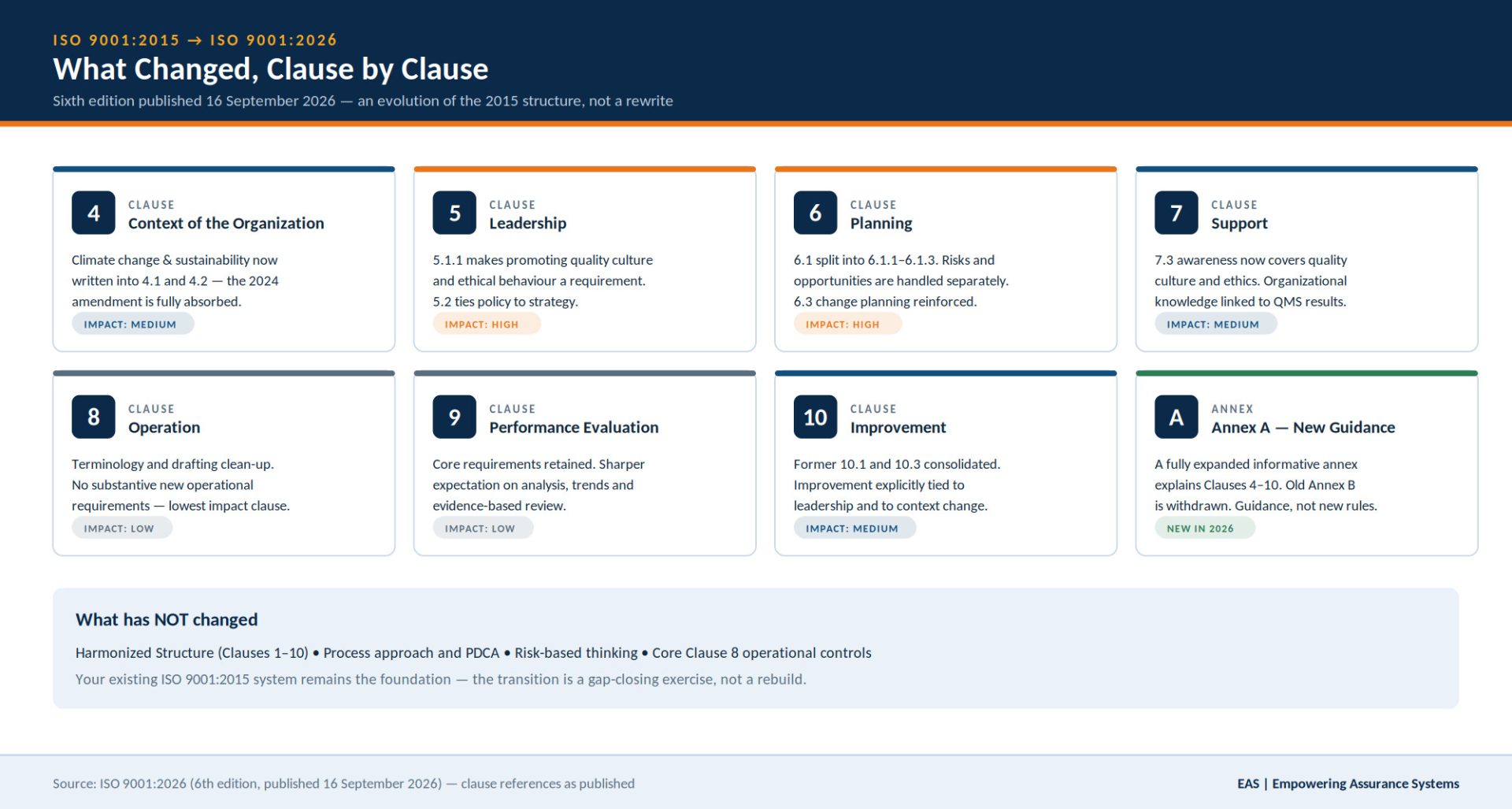
ISO 9001:2026 Changes, Clause by Clause
Clauses 1 to 3 — Scope, Normative References, Terms and Definitions
Clause 3 is where a quiet but practical change sits. ISO 9001:2026 now carries the relevant quality management terms within the standard itself, aligned to the Harmonized Structure and to ISO 9000:2026, which was published in May 2026. Previously you had to hold a second document to read the first one properly.
Two definitions matter more than the rest, because they are new anchors for requirements elsewhere: quality culture and ethical behaviour. Once a term is defined in Clause 3, it can be audited against in Clauses 5 and 7. That is precisely what has happened.
Clause 4 — Context of the Organization
4.1 Understanding the Organization and Its Context
The 2024 climate change amendment is now fully integrated. Your organisation must determine whether climate change is a relevant issue in its context. Note what the requirement does and does not say: it asks you to consider and conclude, not to build a carbon programme. An organisation that determines climate change is not a relevant issue for its quality outcomes, and can show how it reached that conclusion, is conforming.
In practice this is the difference between a one-line entry in your context analysis and a finding. Most organisations will find at least one honest link — supply chain disruption from extreme weather, regulatory change affecting product specifications, customer sustainability requirements flowing down as contractual conditions, or energy and material availability affecting process stability.
4.2 Understanding the Needs and Expectations of Interested Parties
The companion half of the climate amendment sits here: relevant interested parties can have requirements related to climate change. Beyond that, expectations around identifying interested parties and tracking what they actually require have been sharpened rather than expanded.
4.3 and 4.4 — Scope, and the QMS and Its Processes
Drafting improvements and clearer language. If your scope statement and process map were sound under the 2015 edition, they remain sound. Re-issue documents to reference the 2026 edition, and move on.
Clause 5 — Leadership
This is one of the two clauses that genuinely changes what an auditor will ask you for.
5.1.1 Leadership and Commitment — General
Top management must now demonstrate leadership and commitment by promoting a quality culture and ethical behaviour. In the 2015 edition, anything resembling this lived in guidance and in the quality management principles — useful, but not auditable. It is now part of the requirement set, sitting alongside the familiar obligations to take accountability for QMS effectiveness, ensure resources, and engage and support people.
The obvious question is what an auditor can reasonably ask to see. The answer is behavioural evidence, not a new procedure: leadership communications that name quality culture and mean something by it; a code of conduct or ethics policy that is connected to the QMS rather than filed separately by HR; how conflicts between quality and delivery pressure are actually resolved and recorded; management review minutes that discuss culture as a topic and not as a heading.
5.2 Quality Policy
The quality policy must now take account of the context of the organisation and support its strategic direction more explicitly than before. The framed statement in reception that could belong to any organisation in any industry is the thing this change is aimed at. If your policy would read identically at a competitor’s site, it does not reflect your context.
5.3 Organizational Roles, Responsibilities and Authorities
Substantially unchanged. Clarified language only.
Clause 6 — Planning
The second clause with real consequences, and the biggest structural change in the standard.
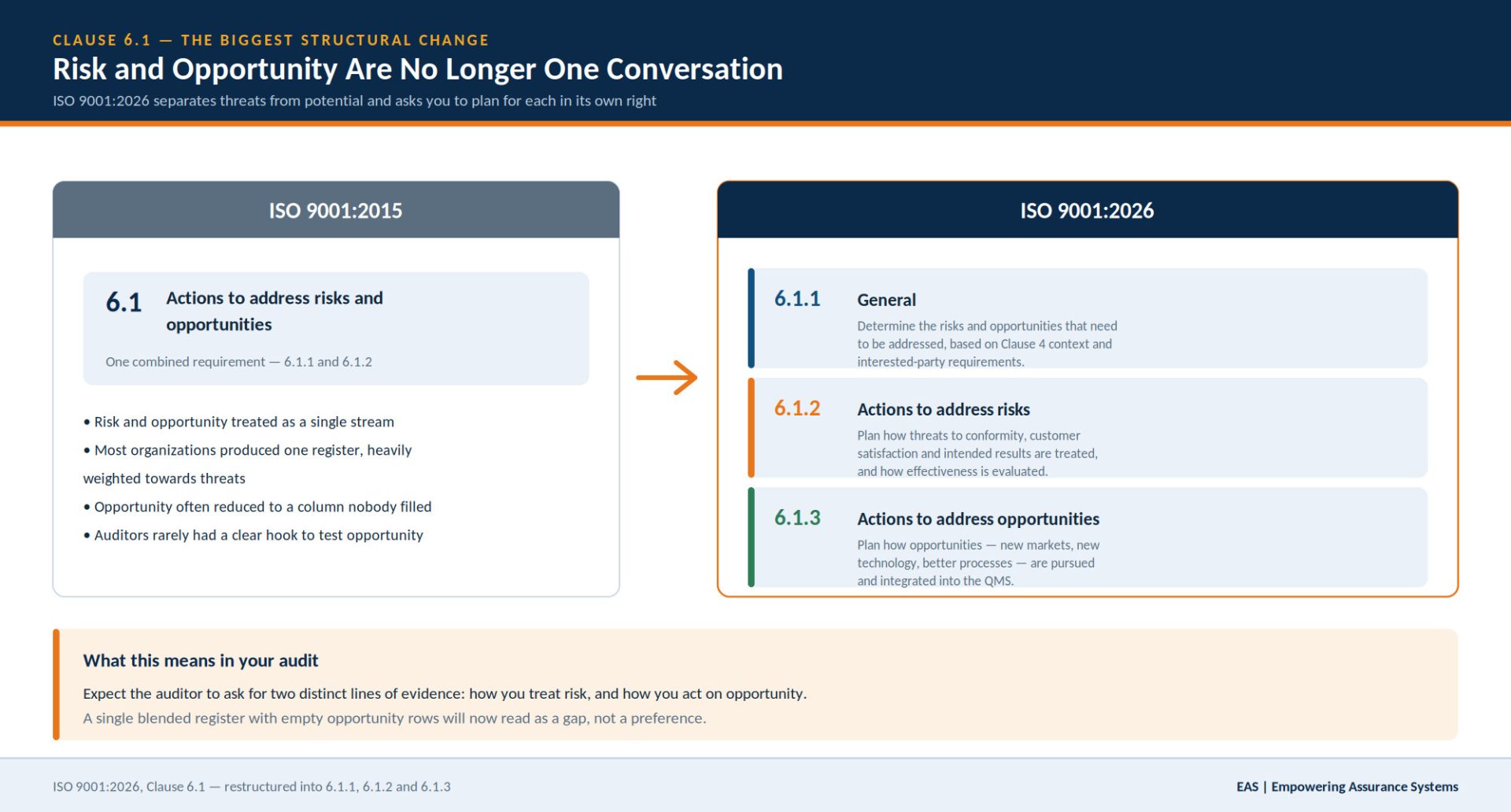
6.1 Actions to Address Risks and Opportunities
In ISO 9001:2015, risks and opportunities were addressed together in a single stream. The predictable result, across hundreds of thousands of certified organisations, was a risk register with a heavily populated threat column and an opportunity column that had been filled in once, during implementation, and never revisited.
ISO 9001:2026 separates them. Clause 6.1 is restructured into sub-clauses that distinguish the determination of risks and opportunities from the planning of actions for each — a general requirement, then actions to address risks, then actions to address opportunities. The guidance in Annex A on this clause is significantly expanded.
What this means practically: your organisation needs two visible lines of thinking. One asks what could stop you delivering conforming product and satisfied customers, and how you treat it. The other asks what could make you materially better — a new market, a process redesign, an automation opportunity, a capability you could build — and how you pursue it. Opportunity is no longer a column. It is a planning obligation with its own evaluation of effectiveness.
6.2 Quality Objectives and Planning to Achieve Them
Requirements are broadly retained, with a firmer expectation that objectives connect upward to strategic direction and downward to the processes that deliver them. Objectives that exist only in the quality manual, disconnected from how the business measures itself, sit awkwardly against the revised Clause 5.2.
6.3 Planning of Changes
Reinforced. Change management in the 2015 edition was three short bullet points that many organisations satisfied with a change log. The 2026 edition strengthens what is expected around planning changes to the QMS, including how changes are communicated, monitored, evaluated and reviewed — so that changes support the intended results rather than quietly undermining them.
If your organisation has been through an ERP implementation, a site relocation, a leadership restructure or an acquisition since your last audit, this is the clause that will be tested against those events.
Clause 7 — Support
Clause 7 has been restructured and tidied throughout, with one substantive addition and one useful extension.

7.1.6 Organizational Knowledge
Expanded, with knowledge explicitly linked to achieving the intended results of the QMS. This is a clause many organisations have treated lightly since 2015 — a note that experienced staff exist and that training records are kept. The revision pushes towards something more deliberate: what knowledge your processes actually depend on, where it currently sits, and what happens to your intended results when the person holding it leaves. For organisations facing generational turnover in skilled roles, this is worth real attention.
7.3 Awareness
Everyone doing work under your organisation’s control must now be aware of the quality culture and ethical behaviour of the organisation, in addition to the existing requirements around the quality policy, relevant objectives, their contribution to effectiveness, and the implications of not conforming.
This is the point at which culture stops being a boardroom topic. Induction content, toolbox talks and refresher training all need updating, and — more demandingly — the people receiving them need to be able to say something credible when an auditor asks. Awareness has always been tested by conversation on the shop floor rather than by signature sheets, and that will not change. It is also the practical reason to put your own people through ISO 9001 internal auditor training before the transition audit rather than after it.
7.2, 7.4 and 7.5 — Competence, Communication, Documented Information
Clarified wording. Documented information requirements are not materially expanded. Your existing document control arrangements carry over; update the references to the 2026 edition as you revise each document rather than in one large exercise.
Clause 8 — Operation
The clause that carries the most requirements is the clause that changed least. Clause 8 sees terminology alignment and drafting improvements, without substantive new operational requirements. Design and development, control of externally provided processes, production and service provision, release and nonconforming output all carry forward.
For most organisations this is the most reassuring paragraph in the standard: the part of your system that touches the product every day is the part you do not have to reopen.
Clause 9 — Performance Evaluation
Core requirements for monitoring, measurement, analysis and evaluation, internal audit and management review are retained. The revision sharpens the expectation that analysis produces something — trends, insight, decisions — rather than a monthly pack that is tabled and noted.
Two practical consequences. Your internal audit programme needs its criteria updated to the 2026 clause set, including the new culture and opportunity requirements. And your management review agenda needs inputs that cover quality culture and the effectiveness of actions taken on opportunities, not only on risks.
Clause 10 — Improvement
Clause 10 has been consolidated. What was previously split across 10.1 and 10.3 is brought together into a cleaner treatment of continual improvement, and the guidance explains that improvement can be prompted by changes in context, by risks and opportunities, and by the adoption of new technology. Leadership’s role in driving and supporting improvement is made more explicit, connecting Clause 10 back to Clause 5. Clause 10.2 on nonconformity and corrective action is unchanged in substance.
Annex A — The Genuinely New Content
The most substantial addition in the 2026 edition is not a requirement at all. Annex A has been significantly expanded into clause-by-clause guidance covering Clauses 4 to 10, and the former Annex B has been withdrawn with its content consolidated.
Annex A is informative. It adds no obligations. But it is now the first place to look when a requirement is ambiguous, and it will shape how auditors interpret the new culture and opportunity requirements. Anyone preparing for transition should read it before reading commentary about it.
What Has Not Changed in ISO 9001:2026?
It is worth stating plainly, because anxiety about a new edition tends to outrun the facts.
- The Harmonized Structure and the ten-clause numbering are unchanged, so integrated management systems stay aligned.
- The process approach and PDCA remain the organising logic of the standard.
- Risk-based thinking is retained — it has been clarified, not replaced.
- There is still no requirement for a quality manual, a management representative, or a prescribed documented procedure set.
- Clause 8 operational controls carry forward essentially as they were.
- Existing ISO 9001:2015 certificates remain valid through the transition window.
ISO 9001:2026 Transition Timeline
ISO 9000:2026 was published in May 2026, the FDIS of ISO 9001 circulated in July 2026, and ISO 9001:2026 was published on 16 September 2026. Publication is the date that matters, because the transition clock runs from it.
A three-year transition window is expected, consistent with the move from the 2008 to the 2015 edition, which ran from September 2015 to September 2018. The exact deadline is set by the International Accreditation Forum communiqué rather than by ISO, so confirm dates with your certification body before you build a plan around them. Certification bodies themselves also need their accreditation extended to the new edition before they can issue certificates against it.
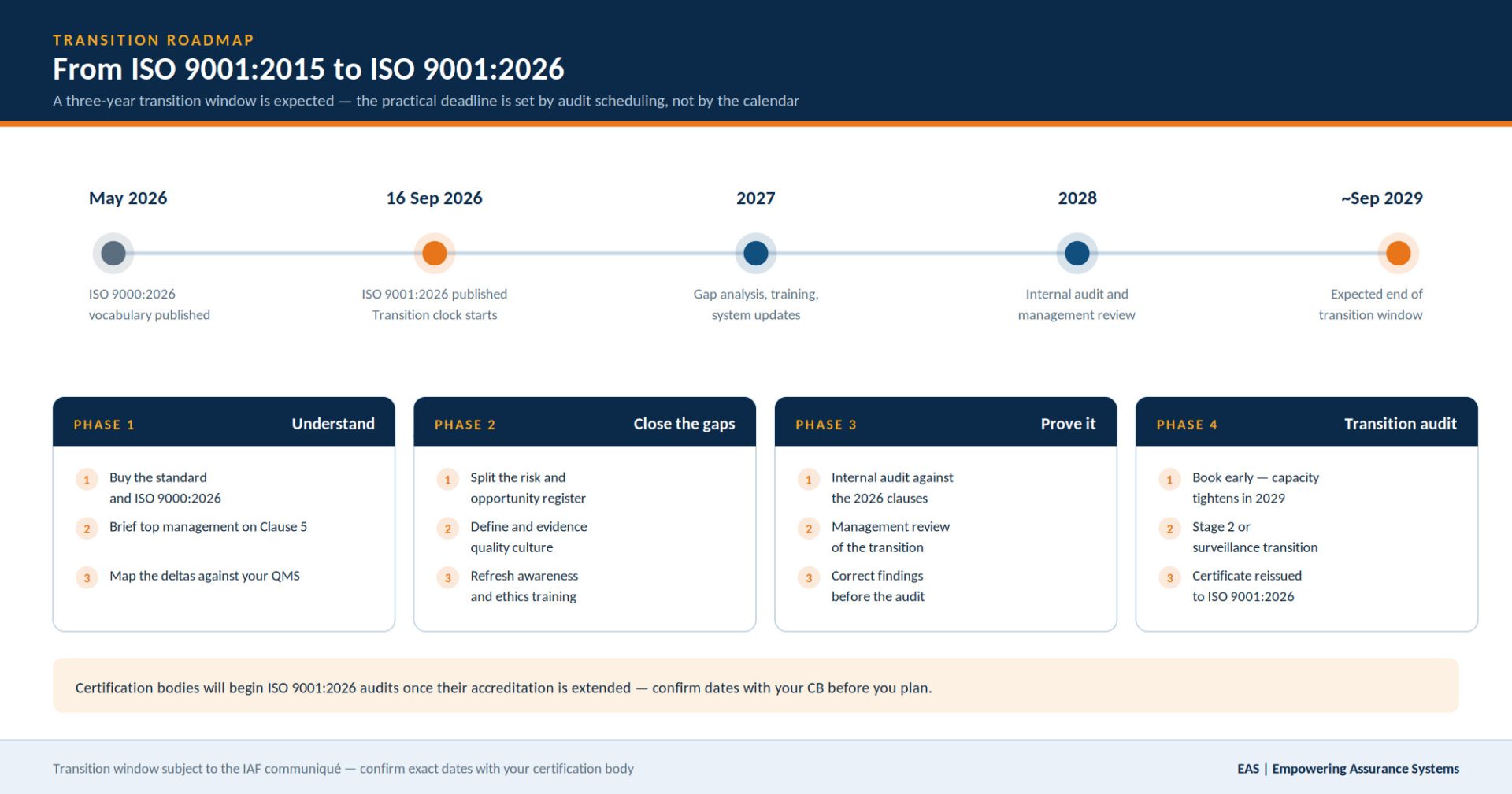
A Practical Transition Plan
Three years sounds generous. It is not, once you account for the fact that behavioural evidence needs an audit cycle to accumulate and that certification body capacity tightens sharply in the final year of any transition.
Months 1 to 3 — Understand
- Obtain ISO 9001:2026 and ISO 9000:2026. Work from the standard, not from summaries — including this one.
- Brief top management specifically on Clause 5. This is the change that requires their behaviour, not the quality team’s paperwork.
- Run a structured gap analysis, clause by clause, and rate each gap by the time it takes to close rather than by effort.
Months 4 to 12 — Close the Gaps
- Separate your risk and opportunity registers, and populate the opportunity side with things the business genuinely intends to pursue.
- Define what quality culture means in your organisation, in your own words, and decide how you will evidence it.
- Update the quality policy so that it reflects your context and strategy specifically.
- Revise induction and refresher training to cover culture and ethical behaviour, and run it.
- Strengthen change planning under 6.3 so that significant changes are communicated, monitored and reviewed.
- Revisit organizational knowledge under 7.1.6 against your critical processes.
Months 13 to 24 — Prove It
- Retrain internal auditors on the 2026 requirements, then audit the full system against the new clause set.
- Put quality culture and opportunity effectiveness on the management review agenda as standing items.
- Close findings and let the evidence build across at least one full cycle.
Months 25 Onwards — Transition Audit
- Book with your certification body early. Capacity in the final year of a transition is the single most common cause of missed deadlines.
- Transition is usually handled at a surveillance or recertification audit, with additional time allocated.
- Your certificate is reissued to ISO 9001:2026 once findings are closed.
If you are running the same exercise on other standards, the ISO 14001 migration lead auditor training and ISO 45001 migration lead auditor training courses follow the same shape, and the upcoming dates for all of them sit on the EAS training schedule.
Five Transition Mistakes to Avoid
- Treating culture as a document. Writing a quality culture policy and filing it satisfies nobody. The requirement is behavioural, and it is tested by asking people questions.
- Leaving the opportunity register empty. Under the 2015 edition a thin opportunity column was tolerated. Under 6.1.3 it reads as a gap.
- Waiting for your certification body to tell you. Certification bodies transition their own accreditation first. Your preparation should be under way before they call.
- Rewriting the whole system. This revision does not require it, and a wholesale rewrite introduces more nonconformity risk than it removes.
- Booking the transition audit late. The last six months of any transition window are the worst time to need an auditor.
Preparing Your Team for ISO 9001:2026
The 2026 revision is modest in volume and demanding in the kind of evidence it asks for. The organisations that transition smoothly will be the ones whose people understand why the requirements changed — not just which clause numbers moved.
EAS (Empowering Assurance Systems) supports organisations across India, the UAE, Malaysia, Singapore, Indonesia, Australia and the USA with:
- ISO 9001 Lead Auditor training — the IRCA-accredited course, being updated for the sixth edition, for auditors who need to audit against the new clause set.
- ISO 9001:2026 transition and awareness sessions — short-format briefings for management teams, internal auditors and process owners.
- Internal auditor training for organisations rebuilding their internal audit programme around the 2026 requirements, alongside the wider ISO training course range.
- Gap analysis and implementation support — a structured clause-by-clause review of your existing QMS against ISO 9001:2026, with a prioritised closure plan.
- ISO 9001 certification itself, and ISO 14001 and ISO 45001 certification where the transition is part of an integrated programme.
Start your transition now.
Talk to the EAS team about a clause-by-clause gap analysis of your quality management system, or book your people onto an ISO 9001 Lead Auditor or transition course. Contact us to discuss your transition plan.
This article summarises the changes introduced by ISO 9001:2026 for general guidance. Clause references reflect the standard as published. Organisations should work from their own licensed copy of ISO 9001:2026 and confirm transition dates with their certification body.
Frequently Asked Questions
What happens if we miss the transition deadline?
Certificates issued against a withdrawn edition cease to be valid once the transition deadline passes. Recovering from that position usually means a fresh certification cycle rather than a transition audit, which takes longer and costs more than transitioning on time.
When can certification bodies actually start issuing ISO 9001:2026 certificates?
Not immediately. A certification body has to have its own accreditation extended to the 2026 edition before it can issue certificates against it, and accreditation bodies work through that queue after publication. Ask your certification body directly when its accreditation is expected to cover the new edition, because it sets the earliest date your transition audit can happen.
We are not certified yet. Should we certify to ISO 9001:2015 now, or wait for 2026?
It depends on how soon you need the certificate. Certifying to the 2015 edition now gives you a valid certificate immediately, but you will transition later within the same window. Waiting means building the system against the current edition from the start and avoiding the second exercise — at the cost of not holding a certificate in the meantime. If a customer or tender needs the certificate this year, certify now.
Will transitioning cost extra?
Transition is normally handled at a scheduled surveillance or recertification audit with additional audit time allocated, rather than as a separate visit, so the incremental audit cost is usually modest. The larger cost is internal — training, gap closure and the internal audit cycle that produces the evidence. Your certification body will quote the audit element; ask early, because that quotation also secures a slot.
Do we need ISO 9000:2026 as well as ISO 9001:2026?
ISO 9001:2026 now carries the quality management terms it uses within the standard itself, so you can read it without a second document. ISO 9000:2026 is still worth having where your team debates the meaning of terms, or where you write procedures that quote definitions, but it is no longer a practical necessity for reading the requirements.
We are certified to ISO 14001 and ISO 45001 as well. Does this break our integrated system?
No. The Harmonized Structure is retained and the alignment between standards is improved rather than reduced. Plan the ISO 9001 transition as part of your integrated audit programme rather than as a separate project.

